
Carrom Rules for Beginners: How to Play and Keep Score
Carrom looks simple enough to pick up by watching. It mostly is. What catches people out is the scoring and the queen, which is where a game that felt easy suddenly has rules you did not know about.
This is the whole thing, in the order you meet it.
The board
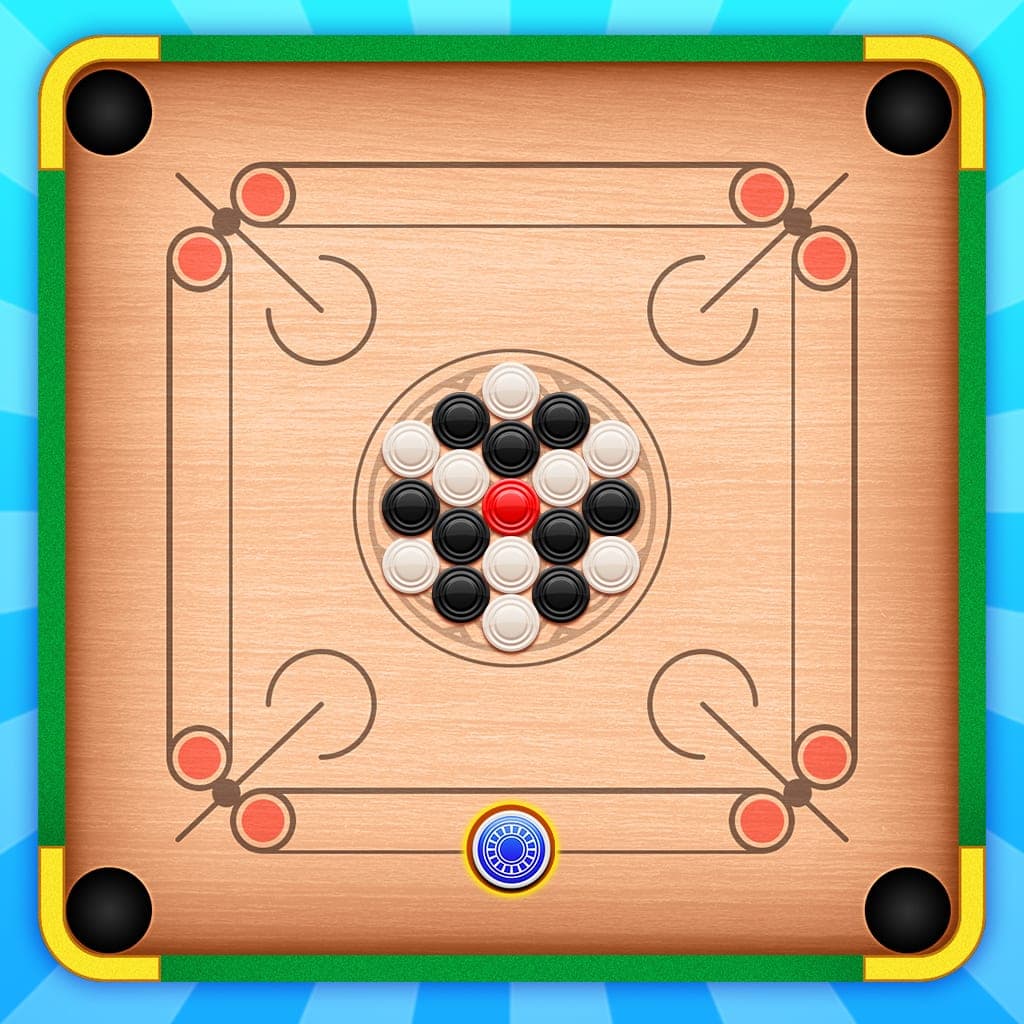
A square wooden board with a pocket at each corner and a circle in the middle. You get nineteen pieces: nine white, nine black, and one red. The red one is the queen.
You also get a striker, which is larger and heavier. You never pocket the striker on purpose. It is the thing you flick, not the thing you are aiming to sink.
The setup
The queen goes in the centre circle. The remaining eighteen pieces go around it in two rings, alternating white and black, packed tight so the whole arrangement is a flower shape held together by nothing but friction.
That first break shot scatters them. How well you scatter matters more than beginners expect - a soft break leaves everything clustered in the middle where nothing is pocketable.
Who breaks, and who plays which colour
A toss decides who breaks. The player who breaks plays white, and the other player plays black. White goes first, so the break is a small advantage, and in a longer match the break usually alternates between boards.
In a doubles game, partners sit opposite each other and share a colour. Turns go around the board, so you and your partner never play one after the other.
Playing a turn
You place the striker anywhere on your baseline, the two parallel lines on your side, and flick it with one finger.
The striker must touch both baseline circles, or cross both lines, depending on which local rule you use. It cannot be placed touching a base line at an angle that skips one.
If you pocket one of your own pieces, you go again. Keep pocketing and you keep the board. A turn only ends when you fail to sink one of yours.
That is why carrom rewards planning: a good player does not just sink a piece, they sink it in a way that leaves the next one available.
How to hold and flick the striker
There are two common grips. With the index finger, you rest your hand on the board and flick forward with the fingertip. With the middle finger, you brace it against your thumb and release it like a spring. Both are allowed, and most players use whichever feels steadier.
What matters more than the grip is keeping your wrist still. The flick should come from the finger alone. Beginners tend to push with the whole arm, and that is where both the extra power and the missed aim come from.
Fouls
The penalty for a foul is always the same shape - you give a piece back and your turn ends.
- Pocketing the striker. You return one of your pocketed pieces to the centre.
- Pocketing an opponent's piece. It stays down, and it counts for them.
- Pocketing your last piece and the striker together. Costly, and it happens more than you would think.
- The striker leaving the board. Same penalty.
- Touching a piece with anything but the striker.
None of these end the game. They just hand momentum to the other side, which in carrom is most of the battle.
The queen
The red piece is worth extra, and you cannot simply take it.
To keep the queen you must pocket it and then pocket one of your own pieces on the very next shot. That second shot is called covering the queen. Sink the queen and miss the cover, and the queen comes back to the centre.
You also cannot pocket the queen as your final piece. It has to be covered by something, so the queen can never be the last thing you sink.
Under the official rules you must have pocketed at least one of your own pieces before you are allowed to take the queen at all. Plenty of home games skip that rule, so agree on it before the break.
Most close games turn on this rule. A player who takes the queen early and covers it cleanly is usually ahead by more than the points suggest.
Scoring
Whoever clears all their pieces first wins the board. Their score is the number of pieces the loser still had on the table.
The queen adds three points, but only to a player who has already won that board. If you covered the queen and then lost the board, the queen gives you nothing.
Games are played to twenty-five points, or eight boards, whichever comes first. Once a player passes twenty-one, the queen stops counting for them.
A scoring example
You clear all nine of your white pieces while your opponent still has four black pieces on the board. You win that board and score four points.
If you also covered the queen during that board, you add three more, for seven. If your opponent had covered the queen instead, they would get nothing for it, because they did not win the board.
What new players get wrong
- Flicking too hard. Power scatters the board and leaves you with nothing to aim at. Most good shots are gentler than they look.
- Ignoring the queen until late. By then it is usually sitting somewhere impossible.
- Taking the easy piece every time. The easy piece is often the one holding a cluster together, and sinking it hands your opponent three clean shots.
- Forgetting the cover. Sinking the queen feels like a win and means nothing on its own.
Practising the aim
The one thing that improves fastest is angles - knowing where a piece goes when you hit it slightly off centre. That is muscle memory, and it comes from volume rather than thinking.
Carrom Jim plays in the browser with no download, which makes it a reasonable way to get those repetitions in when there is no board nearby. The physics behave like the real thing, so what you learn about angles carries over.
Learn the queen rule properly and you will already be ahead of most casual players.
Frequently asked questions
How many pieces are there in carrom?
Nineteen: nine white, nine black and one red queen. The striker is extra and is not counted as a piece.
How many points is the queen worth in carrom?
Three points, but only if you cover it and then win that board. Once a player has passed twenty-one points, the queen no longer adds anything for them.
What happens if you pocket the striker?
It is a foul. One of your pocketed pieces goes back to the centre and your turn ends.
Can you pocket the queen first?
Under the official rules, no - you must pocket at least one of your own pieces first. Many casual games allow it, so check the house rule before you start.
How do you win a game of carrom?
Win boards by clearing all your pieces first. Each board scores the pieces your opponent has left, plus three for a covered queen. The first player to twenty-five points, or the leader after eight boards, wins the game.
Can two people play carrom?
Yes, and that is the most common format. You sit opposite each other, one plays white and the other black. Four people can also play as two teams of partners sitting across from each other.